Search This Blog

Showing posts with label case study. Show all posts

Wednesday, October 9, 2019

Preparing for Peak Season with Smart Warehouse and Fulfillment Solutions

This Case Study explains why Retailers need immediate Warehousing and Fulfillment help before television advertising goes live. Download it free here: https://myeducationmanager.tradepub.com/c/pubRD.mpl?secure=1&sr=oc&_t=oc:&qf=w_schf21


 https://myeducationmanager.tradepub.com/c/pubRD.mpl?secure=1&sr=oc&_t=oc:&qf=w_schf21

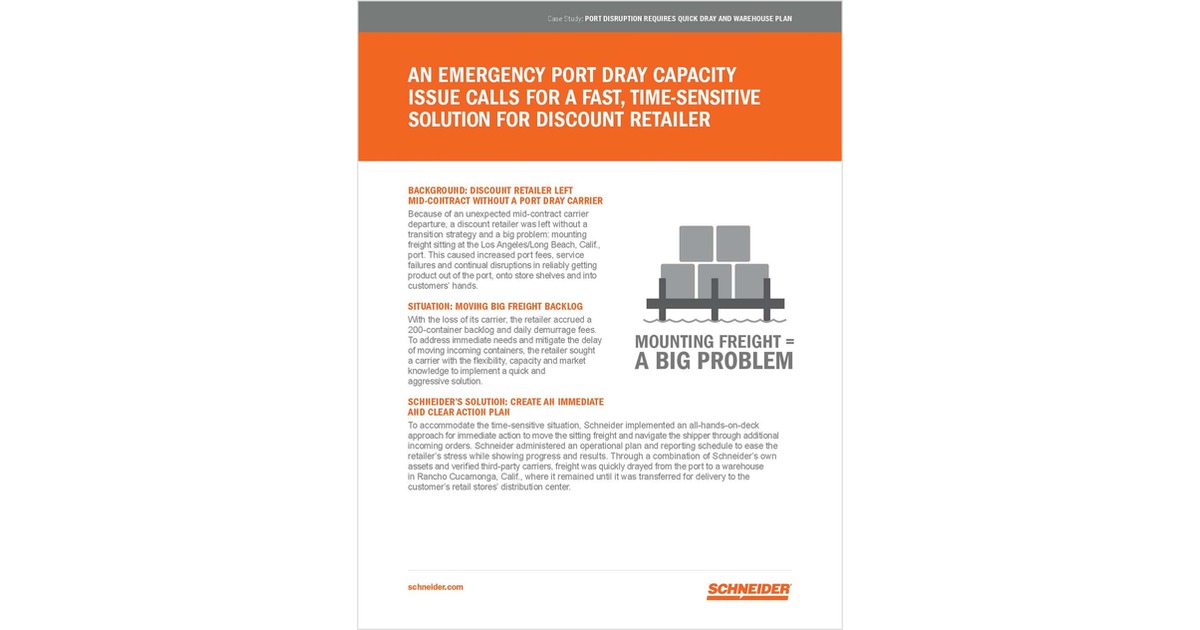
Because of an unexpected mid-contract carrier departure, a discount retailer was left without a transition strategy and a big problem: mounting freight sitting at the Los Angeles/Long Beach, Calif., port. Make sure you have a flexible solution to back you up during your peak season.  
If you're looking for more information on Preparing for Peak Season with Smart Warehouse and Fulfillment Solutions, download the free whitepaper: https://myeducationmanager.tradepub.com/c/pubRD.mpl?secure=1&sr=oc&_t=oc:&qf=w_schf21


https://myeducationmanager.tradepub.com/c/pubRD.mpl?secure=1&sr=oc&_t=oc:&qf=w_schf21

Tuesday, May 30, 2017

Two takes, Coke and Pepsi


Announcer: Until recently many Americans had not thought of the rest of the world as their marketplace. Perhaps this can be expected because of the size and traditional importance of the U.S. However, while we were looking at our domestic market so was the rest of the world. Business competitors from around the globe targeted our relatively free and wealthy markets and American businesses found themselves facing foreign competitors,..especially from Western Europe and Japan. Such competitors as Mercedes from Germany, Shell from Holland, and Sony from Japan. And recently globalization of the marketplace has accelerated due to the advancements of telecommunications and transportation. We must respond to these competitive threats by seeing and seizing the opportunities in the world market. As we look to the global marketplace we will notice that by 1997, consumer s in 12 countries have higher incomes than we do. When we think of the U.S. as having only 5% of the world’s consumers, we can see the other 95% of the world’s population as an immense opportunity. Many U.S. firms are already in the world market, for instance McDonalds is a successful U.S. company that has been able to see and seize opportunities in Europe and Asia as well as the former Soviet Union. The question marketing managers have to ask is, what do we have to do differently to market goods and services internationally? First, because there are more than 175 different countries, and most firms have limited resources, we have to start with a global market assessment to match firm and product strengths with market opportunities in order to target markets with the best prospects. Next, we have to develop an understanding of which aspects of the 4 P’s can be standardized across countries and which have to be adapted for some or all countries. In domestic marketing we tend to focus on the managing the 4 P’s, price, product, place and promotion with less consideration of environmental variables because these are similar for our home markets. However, in the international markets the differences is in the political, economic or cultural variables from country to country may require the marketing managers to adapt some or all of the marketing mix. Observe how two familiar and successful U.S. corporations have responded differently to this issue of global standardization versus cross national adaptation. Coca-Cola is an example of a truly global company. Coca-Cola leads in sales of soft drinks around the world. IT outsells its closest competitor Pepsi-Cola by more than 3 to 1 outside the United States. For instance consumers in the United Kingdom, France and Germany have made Coke their most frequently purchased soft drink. Since Coke enjoys global appeal, it lends itself to a standardized global marketing strategy. For instance, Coke’s secret formula is used globally and its theme “Can’t beat the feeling” is now a familiar theme in many countries. While Coke is sold in most countries with few changes in its packaging, government legislation in Taiwan and Korea, require Coke to use the national language on all Coke products. The image on Coke’s products varies in markets. For instance, Coke uses the strategy in some countries which promotes the product as an “all occasion” drink to be shared
among friends and family. In others Coke uses a different appeal, [showing of ads here]. Sometimes Coke uses popular teen idols from the foreign country to promote its products in that country [shows ads here]. The Spanish TV ad features Angel Ferreira, while the second ad recently shown in Guatemala, features a Latin American star. Coke uses a very different approach in Thailand. Rather than stressing the familiar themes from other countries, their ad shows young people dreaming about a modern future for Thailand and themselves. The message at the end of the ad means, “from our hearts , Coca-Cola for Thailand”. Japan is also a major market for Coke. The company now has 70% of the Japanese Cola market with its flagship brand and 20% for Coca-Cola Light. Initially, Diet Coke did not sell well in Japan. Japanese women do not want to drink anything clearly labeled as a Diet product. Sales finally took off after Diet Coke was reformulated and repositioned as Coke Light. Contrary to what some people may think, American culture is very popular with young people in Japan. In this ad Coke offers its Cola as a link between Japanese youth and popular American culture. Many firms, such as Coca-Cola’s closest competitor Pepsi-Co Incorporated choose to form strategic alliances, such as joint ventures in international markets. They form these alliances with foreign nationals in order to gain local experience, to deal with different legal, political, economic and cultural environments. While Coke has much higher sales than Pepsi globally, the situation is reversed in Russia, where Pepsi has such an alliance. [Black and white news footage of then President Khrushchev and then U.S. President Nixon cutting an opening ceremony ribbon] Voice of announcer, “1959, the Moscow Trade Fair , Soviet citizens have their first taste of Pepsi-Cola, a soft drink from the USA [President Khrushchev drinking Pepsi at the Fair] among them Premier Nikita Khrushchev who finds Pepsi most refreshing. Donald M. Kendall, then Pepsi-Cola International President knew this event represented something larger. For the next 14 years he dedicated himself to establishing a new kind of bond between the Soviet and the American people. In 1973, the world press announces a unique breakthrough in International Cooperation, Pepsi and the Soviet Union signed an historic counter trade agreement. It opens the huge American consumer market to Soviet vodka exports and establishes the first production and sales of an American consumer product in the Soviet Union. From the Start, the Soviet Pepsi partnership has been dedicated to quality and technological innovation. Pepsi helps Soviet bottling plants arrange financing for the latest equipment to expand production, quality and quantity. [Speaker: Gulyam- Kadir A. Adylov- Bottling Plant Manager Uzbekistan on screen] Adylov (translation): “Pepsi helps us with quality control and we don’t let down the Pepsi trademark”. Pepsi product development experts and their Soviet partners are creating a full line of new soft drinks to meet consumer demand. Pepsi’s lemon soda, Fiesta, developed specifically for Soviet bottlers has become immensely popular with the Soviet public. Soviet bottlers have begun producing “Tanis” a new orange flavored soft drink with Soviet grown white grape juice as a key ingredient. Diet Pepsi marks the Soviet Union’s first production of a sugar- free soft drink. And Pepsi pioneered entertaining commercials on Soviet television. Translation of Anatoly Belichenko, First Deputy Chief of Food Resources in the USSR: “Pepsi has been very flexible, and has helped us with the problem of the non-convertible ruble [Soviet currency]. They worked with us to find products to export from the Soviet Union and they helped us build Pepsi production in the Soviet Union by exporting vodka to the United States”.
The Pepsi- Soviet partnership is a countertrade agreement which protects Soviet hard currency reserves.
Pepsi-Cola is imported as a concentrate for manufacturing into soft drinks by Soviet plants. And concentrate is countertraded for Stolichnaya Vodka, the first Soviet consumer product ever sold in the United States. And in the United States, where Stolichnaya is more commonly known as “Stoli”, consumer response to Soviet Vodka has been excellent. Stolichnaya sales have increased more than 800% since 1972 [until 1989 as shown on graph beginning in 1972 with sales of 20,000] and now exceed over one million cases a year. Donald M. Kendall, the man who brought Pepsi to the Soviet Union: 

“ Well, one thing about the Soviets which I think a lot of people don’t understand is that first of all when you are negotiating with them, they do their homework, so you better make sure you do your homework and better know what you are talking about and what you want to do. The other thing you will find with the Soviets is that they are extremely loyal to companies and people that they deal with. If you establish a long term relationship with the Soviets, they live up to those agreements and contracts. I fact there have been periods where we have operated in the Soviet Union where we had no written agreement”. 

Today, Pepsi-Co has 85 joint ventures scattered throughout the former Soviet Union and other communist and formerly communist countries. It is also a global company, rooted in the Pepsi- Cola international family, Pepsi’s local partners in 150 nations. 

We have seen that one key to success in international marketing is to understand that the environmental variables may interact with the marketing mix differently from country to country, thus requiring some adaptation. Conversely, in some markets, or with some products, similarities may overshadow local differences, allowing for standardization. For instance, Coca- Cola is able to use its secret formula in almost every country, leading to economies of scale. With more than 175 countries in the world, we cannot know in advance of all these environmental variables, and how they will interact with the 4 P’s in each market. But, based on the experiences of Coke and Pepsi, we see that marketing managers have to be sensitive to the important political, economic, cultural or other environmental differences affecting the marketing mix. Discovering the similarities and differences of people and nations around the world, makes international marketing a most interesting and rewarding career. If you are willing to grasp the complexities of the global marketplace, you will be able to help your firm grow, create jobs and make money and friends around the world.

Thursday, July 14, 2016

Hubway Video Case Study Transcript


E-business –New Balance Hubway

Brogan Graham (Hypemaster): E-business is happening at Hubway maybe on one of the highest levels because all transactions happen either online or by touching a touch screen.
Mary McLaughlin (Marketing Director): It really takes probably one time of using the system to actually understand how it works; it is pretty intuitive.
Brogan Graham (Hypemaster): Here’s how bike sharing works. You walk up to any of the stations as a visitor or someone in town who wants to try the system. Each of our stations has the ability to swipe a credit card and print a code and take that code and take out any of the bikes. It’s an interchangeable system so you can take that bike all the way across town and drop it off and you can be done with it; that could be it. The other way to use it is an annual member. We send you a key fob in the mail and that bar code on the back of that key chain basically represents your account so instead of having to go to that terminal, you just walk up to one of the bikes, swipe it, it gives you a green light and you’re off.
Scott Mullen (General Manager)
The Hubway system was conceived as a regional network for Boston, Cambridge, Somerville, Brookline, and the surrounding communities. The total will bring us to about 100 stations and 1,000 bicycles for that initial launch phase. This will be our first full season in Boston. The initial projections were 3,000 members, 100,000 trips in the first 12 months would be considered good; that would be success and we hit those metrics 10 ½ weeks for 100,0000 rides really show you that there’s kind of a nascent demand, you know, people want this. Boston is already talking about expanding by maybe as much as 50%, which could bring 30 more stations just to the city of Boston proper. There’s not a Hubway rep at every station to kind of walk you through the process. I mean it would obviously be unwieldy and that’s a very 1.0 solution to it, you know, to a 2.0 system.
Brogan Graham (Hypemaster): E-business is the fact that Hubway is this gigantic city program with all this hardware and all these people moving bikes and getting people to and from their A and B all day long in the city of Boston. It has no customer service desk; it has no office where you go to get your key.
Scott Mullen (General Manager):
There is a certain degree of kind of tech savvy that most of our annual members have but the casual members as well like they have to swipe a credit card, they deal with the screen, but we make it as seamless as possible, make it as easy as possible because again, this shouldn’t be a big production. Just want to get a bike because I’m going 7 blocks away and we want to make it easy.
Brogan Graham (Hypemaster):
As far as e-business goes, you know, Hubway there is no store or counter to walk up to get your key. Everything is done on our website at the Hubway.com so you put in your information and we mail you a key. If you want to find out about station updates we do a lot of our marketing, a lot of our hype and publicity through Facebook. Twitter is also good for blasting updates and sharing info about cycling infrastructure in Boston and around the world.
Scott Mullen (General Manager)
We really look at social media from a broader context. Social media leads to other types of media is the way we look at things. We use social media not just for marketing but for operations as well.
Brogan Graham (Hypemaster):
We use it sometimes as station updates to say here are station updates. Here at the south station the system just went down and it should go live in a few hours and the amount of followers who want to follow our up to date little tidbits along the way really have gone up. We do email blasts but everything for the most part is done online. All the transactions are done online and even right here with the touch screen at the solar powered station, you know, that’s just interactive there.  There’s no attendant. It’s all just done by using your credit card and using the solar powered touch screen. It’s open all night, it is 24/7, it is cheap and it’s fun.  It’s a cool way to explore a new city. Many people have questions about Hubway and how it works such as what do I do if I have a flat tire? What do I do if I come to rack that’s full of bikes? How do I find the station? All that information is on the Hubweay.com. For example, if you’re on a ride and you do get a flat tire, you walk up to any of the stations and simply press the mechanics button when you dock the bike. That will secure the bike in the station and it will not be released to the next person. The mechanics will come and take a look at it and fix it up and get it back out to the fleet. 
 Scott Mullen (General Manager): Full or empty stations are equally bad to us because that means a member can’t either dock a bike or can’t get a bike when they want one. So it’s all about figuring out how we run the system we have and where does it make the most sense to grow organically outward.  So we have to be smart about our growth so we can meet demands. If you think about a business that is not brick and mortar, that is strictly online maybe it’s selling goods and services or whatever, I mean we leverage the Internet, of course, because that’s how you sign up as an annual member, we have an app called spot cycle, which is how you see where the closest stations are to you and how full or empty they are and you know, and if you maybe need to go somewhere else.  North station is full right now and I’ve got to get my train in 10 minutes, I’m going to go to Stanford and Cause Way a block away.
We did a survey of our members at the end of the year last year and we had about 3,700 which was huge for us because we projected to have about 3,000 after 12 months.
Brogan Graham (Hypemaster):
Between signing up online, touch screens that are solar powered in the street, Smartphones that have free apps that make life easier, the e-business transactions it’s funny, it’s something that older generations don’t necessarily understand or necessarily can get with. A lot of the younger employees here will have their folks still kind of confused on what we do.

Scott Mullen (General Manager):
Smart technology, Smartphones, obviously the Internet…, It’s fundamental to our business.
Wednesday, February 10, 2016

Marketing Research for International Expansion

Marketing Research Case Study: I-Drive Transport


U Drive Transport is largely popular in the United Sates. It all started back in June of 2008 when a brother and sister team Jenna and Karl came up with the idea of U Drive Transport. The whole idea is to provide car in the urban area. You can rent a car for a few hours, the whole day or even the month.  It started in 2009 with only 10 cars by the University of Chicago. Now this company has grown to 20 major city centers and over 500 personnel working for them.  Their whole idea is to take this company into the global market.  They are currently looking at Bail Indonesia for the first global location.
Bali Indonesia is a huge tourist area and the population is 253,609,643 and it is continually to increase for the next 25 years. Based on the trend here in the United States it has shown great success and there nowhere else to go is up. You have to so a need for our product in Bali and make sure there is a supply and demand for U Drive Transport. This proposed research will show that there is a need for car sharing in Bali.
Marketing research is the process of planning, collecting and analyzing data relevant to a marketing decision. (Lamb et al., 2014)  This research would take about a month to conduct to make sure we are making the right decision about opening a company in Bali.
These are the following marketing research problems and opportunity questions for the following proposal:
1.     Is there a demand for U Drive Transport in Bali Indonesia?
2.     What would be our customer base for U drive Transport in Bali Indonesia?
3.     Are there any other companies in the area that provide the same service?
Secondary information originating within the company includes documents such as annual reports, reports to stockholders, product testing results perhaps made available to the new media and house periodicals composed by the company’s personnel for communication to employees, customer’s or others. (Lamb et al., 2014)  Then we will require outside secondary data from government agencies, trade association or other secondary data providers (Lamb et al., 2014)
Primary Data or information collected for the first time. (Lamb et al., 2014) There are several types of getting this information but the two methods that we will use in to getting this information would be Mall Intercept Interviews and Mail Surveys.
Mall intercept interview is conducted in the common area of a shopping mall or in a market research office within the mall. U drive Transport will rent out a space in the mall so they will be able to conduct the interviews. And we will have it set up as a computer-assisted self-interview. That means we will have a computer area set up so the personnel will be able to set at the computer and answer the questions by themselves. Once they are done the will call over the employee and the interview will be done. If they are full the employees will have another area to where they can also do Computer-assisted personal interview. This is where the employee will ask the questions and put the answers in the computer.
Mail Survey have several benefits; relatively low cost, elimination of interviewers and field supervisors, centralized control and actual or promised anonymity for respondents. (Lamb et al., 2014) The problem is with this is a lot of the people will not fill out the survey and send it back. A lot of people look at it as Junk mail and will just throw it away.
Collecting of the Data will happen within a wide variety of city centers in Bali Indonesia. If we go inside the malls so we can reach the target market that we are aiming for.
Once the month is done of the surveying we will analyze all the data to see if it will befit us to go to Bali.  We will get an outside source to put all the data together. We want it to be a one-way frequency table simply record the responses to the question. (Lamb et al., 2014) Really cut and dry will we befit going to Bali.
After data analysis has been completed, the researcher must prepare the report and communicate the conclusions and recommendations to management. (Lamb et al., 2014) We will have the group do a power point presentation and do an oral presentation to the top management.
Then final step is the Follow up. Once everything is said and done. Then management team will take all the information that we provided for them and they will make the final decision. If they need more information this is the time they will let it be known before they make the final decision.  
   
Word Cited page

Lamb, C. W., Hair, J. F., & McDaniel, C. (2014). MKTG7. Mason, OH: Cengage.
Today's Top Picks for Our Readers:
Recommended by Recommended by NetLine

Featured Post

Johns Hopkins Aramco Healthcare Business Case Study

Business Case:   Johns Hopkins Aramco Healthcare    Operations Management Report   Table of Content...

Translate